
Faster BERT Tokenization: Keep the Output Contract Intact
A faster model is not the only way to reduce latency. Text preparation can consume CPU time before the model receives its first token.
On October 15, Hugging Face published Tokenmaxxing BERT, an explanation of new tokenizer optimizations. The headline is about 50× faster encoding than the older 0.23 baseline. That figure combines earlier library changes with this proposal. It is a reported tokenizer result, not a claim about full application speed.
The implementation pull request, #2508, was still a draft when we checked on October 17. Treat this as work under review, not a stable version 1.0 release.
The useful idea: do less work on unchanged text
The proposal uses three techniques: scan eligible ASCII ranges with vector instructions, cache Unicode decisions, and delay output allocation until text changes. These are changes to preprocessing, not to learned model weights.
The author's results vary with language and input length. Chinese text and very short strings need particular care. A broad speed claim is therefore a reason to measure your workload, rather than a reason to replace a dependency immediately. See the announcement and its caveats.
For a retrieval service, start by separating text preparation, model inference, and storage access. Suppose tokenization takes 20% of request time. Even a hypothetical 5× tokenizer speedup reduces total time to 84% of the original: 80% unchanged work plus 4% tokenization. That is about 1.19× faster overall. This calculation is an illustration, not a measurement of this proposal.

A tokenizer has more than one output contract
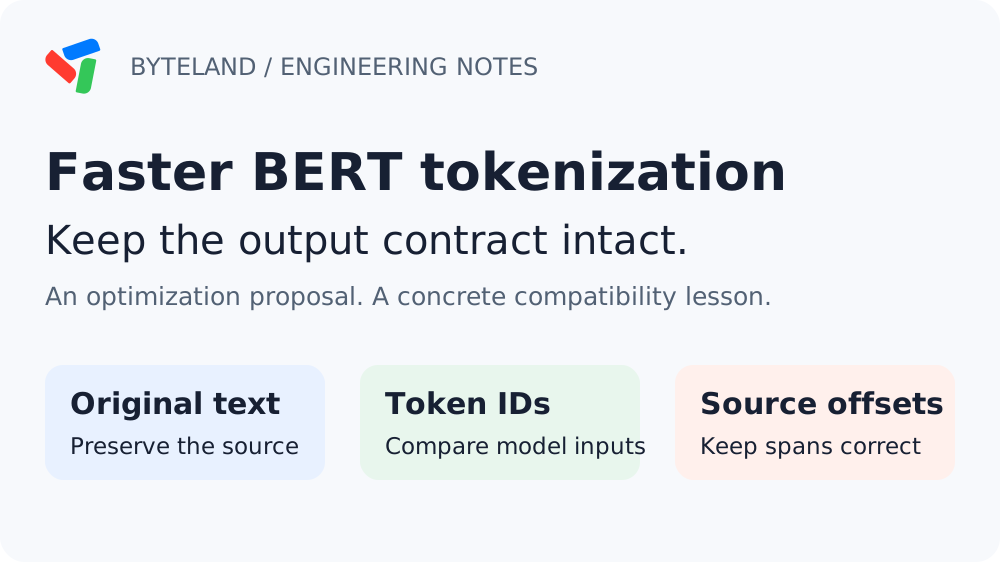
Token IDs are the integer sequence given to a model. Offsets connect those tokens to spans in the original input. Hugging Face's versioned Encoding reference documents both, along with masks and other metadata. We observed these outputs in our 0.23.2 baseline.
That second contract matters in search highlighting, extracted answers, and annotation tools. A token can remain correct while a highlight points to the wrong source text. Comparing only token IDs can miss that application failure.
Unicode also makes visual equality an unreliable shortcut. A visible accented letter can be one code point or a letter followed by a combining mark. The Unicode normalization specification distinguishes canonical normalization from compatibility normalization. These operations do not mean “make all similar-looking text identical.”
BERT adds its own rules. Google's original tokenizer implementation cleans text, adds boundaries around Chinese characters, and applies case and accent handling for uncased input. A BERT normalizer is therefore more than a single Unicode normalization form.
What our baseline check found
We ran tokenizers 0.23.2 with the real bert-base-uncased tokenizer file and its 30,522-entry vocabulary. The inputs included code, log lines, several writing systems, combining marks, whitespace, controls, and empty strings.
This was a compatibility baseline, not a run of the optimized branch. We measured no speedup. The purpose was to identify useful acceptance checks before a later comparison between versions.
All 24 cases produced matching IDs and offsets in batch and single-input encoding. Normalizing each input before encoding also preserved its token IDs in all 24 cases. That did not make every string-level assumption correct.
| Input or check | Observed result | Why it matters |
|---|---|---|
Chinese character 中, normalized twice | Each pass adds boundary spaces; the two strings differ | String idempotence is not a valid general assumption for this BERT normalizer |
Café and Cafe followed by a combining acute accent | Matching token IDs | Visually equivalent forms can share model inputs |
Decomposed Cafe plus accent | The cafe token has source span (0, 4) | This span excludes the removed combining mark |
a, a NULL character, then b | Token ab has source span (0, 3) | A span can include an original character removed during normalization |
| Fullwidth capital letters | Lowercase fullwidth letters remain fullwidth | BERT normalization is not a general NFKC replacement |
Offsets above use the Python API's original-string positions and half-open ranges: the end position is excluded.
Our audit recorded 128 checks: 126 passed, and two string-idempotence hypotheses failed on CJK-containing inputs. Those failures expose a bad test assumption; they are not evidence of a library defect. Standard Unicode normalization forms have their own guarantees. Do not transfer those guarantees to a larger text-processing pipeline without checking its extra steps.
The practical rule is simple: retain the original input and compare the outputs your application actually consumes. Do not replace original-source offsets with positions in the normalized string.
Make a later performance comparison useful
The author's reproducer pins baseline commit fb49a29223724a96f26e061bec8ec7517aa14177 and proposed commit 5b5a3fcc18335eed616ae89adb714a048fed1a31. Its release comparison also includes 0.23.2. These revisions matter more than a moving branch name.
For an adoption test, keep the tokenizer file, configuration, and input bytes fixed. Compare token IDs, offsets, special-token masks, and any truncation or padding behavior that your application uses. Run application tests that consume those outputs. Our small audit does not cover every Unicode sequence or model configuration.
Check binding availability too. The current prerelease documentation lists offsets and several other outputs as unavailable in the rc0 bindings. Do not assume that a faster core already provides every API your application needs.
Only then measure time. Keep short queries separate from long documents. Report languages, byte lengths, batch sizes, thread settings, warm-up, and repeated-run variation. Measure total request latency as well as tokenizer throughput. An improvement in one input group must not hide a regression in another.
Retain the previous dependency version and an explicit rollback condition. A performance change is useful only while the application contract remains intact.
Conclusion
This proposal is worth following because it removes unnecessary preprocessing work. Our baseline check adds a concrete adoption lesson: token IDs, normalized strings, and source offsets answer different questions. Pin the implementation, preserve the correct contracts, and measure the full pipeline before treating a tokenizer headline as an application gain.