
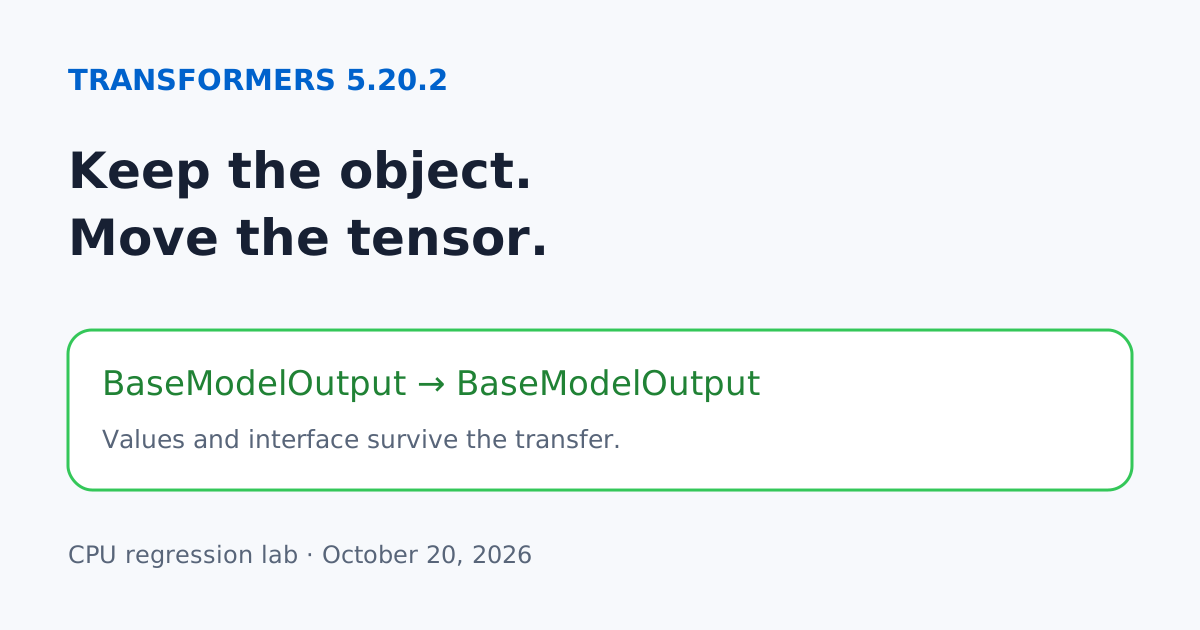
Transformers 5.20.2: Keep the Object When You Move the Tensor
A tensor can keep its values while the object around it loses its behavior. In a generation pipeline, that can stop the next model call.
Transformers 5.20.2, released on October 19, fixes one such failure. A helper that moves tensors between devices converted dictionary subclasses into plain dictionaries. This removed the interface that later code expected.
We compared the 5.20.1 and 5.20.2 source runtimes with the same dependencies. Two tiny models failed on the affected branch before the patch. Both generated tokens after it. Their normal CPU controls passed in both versions.
This is a library regression test. The models use random weights, and the test forces a device-check branch on CPU. It does not measure model quality or verify a GPU transfer.
A model output is more than a dictionary
Transformers returns many results as ModelOutput subclasses. These objects offer named attributes and dictionary-like access. They also support integer or slice access to their non-empty fields. The model output documentation describes this interface.
For example, BaseModelOutput can hold a tensor in last_hidden_state. Code can use result.last_hidden_state to read it. A plain dictionary with the same key requires result["last_hidden_state"] instead.
Those expressions are not interchangeable. A tensor-value assertion can pass even when attribute access fails.
Generation can carry such objects inside another dictionary. A vision-language model can retain image-encoder results for later decoding steps. A recursive device-transfer helper must preserve the structures that those steps consume.

Where the type disappeared
The earlier helper rebuilt every dictionary with a dictionary comprehension. This produced a plain dict, even when the input used a subclass.
The patch in pull request #49731 changes that reconstruction step. It calls the original container class with the moved entries. The tensor, list, and tuple branches remain separate.
The following code shows the changed dictionary branch:
# Earlier branch
return {k: move_to_device(v, device) for k, v in value.items()}

# Patched branch
return type(value)({k: move_to_device(v, device) for k, v in value.items()})
This preserves BaseModelOutput for the case we tested. Its nested tuple also survives. The change repairs an interface contract; it does not change the model weights or add a reasoning capability.
The earlier device-placement change, #49317, introduced recursive movement for inputs in generation. The regression report arrived on October 17. The fix merged on October 19, before the 5.20.2 patch release.
Device placement and typed model outputs are established concepts. The new event is this specific repair.
Reproduce the branch without a GPU
We used CPython 3.12.14, PyTorch 2.14.1+cpu, and one CPU thread. Both Transformers versions ran in separate processes with the same dependency environment.
The fixture creates a small BART model and a small LLaVA model from configuration. They contain 8,768 and 8,352 parameters respectively. No trained weights, images, or tokenizer files are downloaded. The image input is a random tensor.
First, each model runs on its ordinary CPU path. Then the fixture temporarily changes the reported model device to cpu:0. The input tensor still reports cpu. Their comparison selects the transfer branch, while computation stays on CPU.
The upstream issue #49699 documents this technique. Our harness uses a scoped patch that restores the property after the check.
| Generation check | 5.20.1 | 5.20.2 |
|---|---|---|
| BART, normal CPU path | Output shape [1, 4] | Output shape [1, 4] |
| LLaVA, normal CPU path | Output shape [1, 11] | Output shape [1, 11] |
| BART, forced transfer branch | KeyError: 0 | Output shape [1, 4] |
| LLaVA, forced transfer branch | Missing pooler_output attribute | Output shape [1, 11] |
These are observed results from our runs. Each shape describes the returned token tensor, not an accuracy score. The calls request three new tokens with sampling disabled.
We also ran the unmodified targeted test method added by the upstream patch. It failed against 5.20.1 and passed against 5.20.2. That method checks recursive calls, output types, and preparation of generation inputs. We did not run the complete Transformers test suite.
The difference between the two paths is useful evidence. A test that only calls the model with inputs already on the expected device can miss this regression.
Test the container boundary too
Our helper checks covered BaseModelOutput, a nested model output, OrderedDict, an ordinary dictionary, and a tuple of tensors. The patch preserved the expected types in these cases. The ordinary dictionary and tuple controls already passed in 5.20.1.
A separate negative case used defaultdict. Version 5.20.1 converted it to a plain dictionary. Version 5.20.2 raised TypeError because the constructor expected a callable default factory as its first argument.
That result defines a limit of this reconstruction pattern. It is not evidence that a documented Transformers input must accept defaultdict. It does show why the patch should not be described as support for every mapping class.
If your extension passes custom containers, test those exact types. Do not assume that type(value)(entries) is a general serialization protocol. Some constructors need additional arguments or preserve extra state.
Add assertions at the interface
For a device-transfer test, check more than completion:
- Check the output class.
- Read a required attribute or indexed field.
- Check nested container types.
- Check tensor values, shapes, and devices.
- Exercise the normal path and the transfer branch.
- Test unsupported containers separately.
Keep the expected failure cases visible. A report that combines every case into one pass percentage can hide the difference between a repaired regression and an unsupported input.
Our forced-branch test does not establish GPU correctness, multi-device placement, distributed execution, or speed. It also does not assess the other fixes in 5.20.2. Test your actual model, device layout, cache configuration, and dependency set before deployment.
The experiment bundle includes the harness, pinned source references, recorded dependencies, raw results, and reproduction commands. The bundled checks make no model-service calls.
For an application affected by this path, the patch provides a concrete regression target. Preserve the tensor data and the interface that the next step needs.